Tuesday, May 31, 2011

Inspired by Windthread

After Grace over at Windthread, who posted her ecodye set up, and shared lots of beautiful thoughts about working with what is around.


Grace's post made me feel pretty brave. Helped me see a dye spot in the sunshine. Pot, jars, table top, table legs, bucket all found in the garbage. Copper and iron found too. Sunshine makes it all work.


Geranium petals that the guy who lives here has saved all winter.

But I'm in over my head with this. I bought two ounces of indigo last year, on a whim. The only thing I bought for this enterprise. I'm using these instructions, which seem to put me at less risk of somehow poisoning or chemically burning the loved ones.

This is Day Two. I want to batik borders for a long cloth...

Friday, May 20, 2011

Rag of the Day Special Edition: Working with Ecodye, Shibori and Found Cloth


I'm getting back to work on a long cloth that I started in Jude's Contemporary Woven Boro class over the winter. I'm drawn more and more to working with the found cloths I've collected, and looking at the similarities between the ecodyed bits I've been doing with found cloth, and the found cloths themselves. This is a little walnut dyed shibori ah, 'moon'?


The ecodyed bits I have been making remind me in so many ways of the marks on the found cloths. Wear, age, fading and staining all create marks that are like those on ecodyed fabrics.


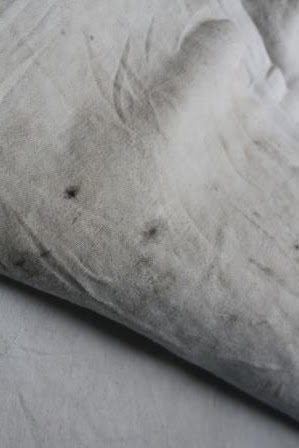
But it is the undeliberate nature of the ecodyed marks that makes me want to match them with the found cloths. Each is unique, a product of processes that aren't controlled. Each of the found cloths bears marks that tell something of its past. These are all cloths that have fallen out of use, and spent considerable amounts of time outside before I found them. The sheet at the top is heavily mildewed, to the point that I thought it was ink-stained.


This faded and abraded velvet and the red below are from a Crazy Quilt- a beautifully stitched, mesmerizingly composed Crazy Quilt- that has spent the entire winter crumpled under a tree in a strip of brush beside the train tracks.


Part of the story of almost all of the found cloths I have is that they have been left behind by a homeless person, someone who likely has a bed for a night in a shelter, but who spends some part of the day seeking some privacy away from an institution. Some place they can kind of make their own.


There is so much grievously wrong about this. It sometimes keeps me from wanting to work with these cloths, keeps me from wanting to see them as beautiful. They aren't just 'lost things with nice marks'. They each are part of a difficult life.


This is a sun-faded shirt- I know it looks like sun and shadows, but these are permanent marks on the cloth. The marks on these cloths are more than just 'wear' or 'age' or 'stains', the kinds of things that normally happen to cloths. I think I want these marks to be information, to be the specific stories of how they were lost.


This little scrap came out of the Crazy Quilt too. You can just make out what I think is one Dragon claw holding on to a pearl.

Finding this familiar and beloved symbol under the mud, well, sharpened my resolve to keep working with these bits. In part it is that there is something to them that I can't replicate with my dyeing experiments- their singular beauty reminds me what I'm striving for.


And maybe it is just a fact that the information they carry around is just there- I can't add to it or subtract it. I can just take them as I find them and see what to do next.


Tuesday, April 19, 2011

Update on Foraging-Scapes: Food


This is an update on 'foraging-scapes', my little cloth project to help me think about pollinators and the work they are doing in our gardens. I'm thinking a lot about the ways their work is creating the landscape that our gardens are part of.


Most of the cloth is made from stuff I have found, except some cast off bits given to me by family and neighbours. I've dyed the cloth using stuff we've found, too- berries, leaves, walnuts, washers for shibori dots, a segment of copper sheeting. The thread is mostly single strands of bamboo yarn, waxed with plain beeswax. This update is about how I've chosen to represent pollinator food- you'll recognize Jude's stitches from Heart Whispering below....


I have been working on representing pollen. While pollinators eat nectar, they rely on the nutrients in pollen for growth, to feed their offspring and to fight off disease.


And pollen comes in the most eccentric shapes. I'm particularly taken by the pollens with hooks- microscopic little curved rays that stick out of individual pollen grains. One of my favorite native plants, Cardinal Flower, produces such wonderfully shaped pollen.


My fascination with these spiny pollens aside, pollinators require a diversity of types of pollen- they are malnourished if they don't have that diversity. So lots of different kinds of pollen are getting worked in too.


These are Jude's thread beads, and at first I was making them as a mass of little bits of pollen, but then I started to think they look like the little clusters of honey pots that the social bumblebees build as food for their offspring. So I'm going to make more of these little clusters here and there.


A note, also, on colours. As far as I have read, bees and hornets and wasps don't see colour, and in particular don't see red. On the other hand, most pollinators can see light in the ultraviolet spectrum. This means that there is stuff in the world, in the garden, that they see that we don't.

The spectacular thing about this- wondrous even- is that many plants produce flowers marked with ultraviolet reflective and absorbent compounds, producing patterns and markings that only the bees can see. So I'm working on this idea, too.

Saturday, April 16, 2011

Update on Foraging-Scapes: Shelter


The cloth is now all mosaiced, and the next steps are more surface stitching and applique.


Since this cloth is about pollinators- bees, wasps, hornets- I am considering ways to represent the things they forage for. Food, water, shelter. The stuff they need.


I've started out by thinking about ways to represent shelter. Some of the dots are meant to represent the entrances to the little tunnels that pollinators use as shelter in our garden, and where they lay their eggs. Most wild pollinators are solitary- they don't live in hives or function in socially differentiated societies as honeybees so famously do. They use tunnels in wood, twigs, stems and the earth.


Within each tunnel a female wasp or solitary bee builds cells-with clay or paper dividers- that each contains an egg and some pollen. We keep dishes of wet clay and water in the meadow garden for them.

These stitches below are inspired by the cells that bald faced hornets make in their big paper nests.


They make their cells out of wood fibers- they chew up wood to make into the paper that is coiled up to make the wall of each cell. If you look closely, the paper in each cell is striped.


The bald faced hornets who built this do live in role-differentiated societies, with workers doing most of the foraging for food once the breeding female has established a colony. She raises this first generation of workers herself, from a small version of the shelter she builds in the spring when she hatches. She feeds them herself. These new workers then expand this nest over the summer, gathering wood fibers and food.

The complexity of all of this is a marvel; and I am amazed that it happens at all. And of course, it makes me acutely aware of what creatures like this need. Habitat. A landscape, a territory, a place to move around, to find what they need. I think we learned that such landscapes are in short supply around here, because almost as soon as we started planting native perennial plants, we started noticing new insects that we had never seen before. The bald faced hornets fed here all summer and built a nest in a new crabapple tree.

What amazes me most is the impact creatures like this have on those landscapes- as builders, but also as pollinators as they search for food. Which will be the subject of the next update.

Rag of the Day - Digest

-shredded shirting, in the mud near Sandy Beach, April 10 2011; still very sturdy

-nylon tent fragment; Gracie's fishing beach April 11 2011; this part was tied in a knot around a nylon rope; brittle, so might not work for sewing

-standard car buffing rag, April ? 2011 Toxic Blob parking lot

-blue, faded to turquoise, parking lot by the Convention Centre; April 3 2011

-about four square inches of shirt, in the mud near Sandy Beach, April 10 2011

Friday, April 8, 2011

Update on Foraging-Scapes


Sharing the work in progress on this little cloth; I'm using Jude Hills mosaic method here, adding eco-dyed bits on a base. The base cloth is mostly from this sheet (former rag of the day entry).


This is the ribbon scrap B found last week.


Even this, which we found during the first real thaw in February, has found its way in.


It is the long bars on the left hand side of this part.


The yellow square above there is dyed with marigolds. All last summer, B would stop and pick the dead heads off of a neighbor's marigolds. The nerve.

This cloth is helping me see such acts of foraging and how they create landscapes, foraging-scapes. Blending ours with the bees and other pollinators. The sheer patch below is dyed with the few black raspberries that dried on the canes last summer. Each little berry was the product of some little pollinator's work.


I'll explain later that all the dots on this are meant to represent the things that bees and pollinators are foraging for- food, water, shelter. More stitching to accompany this idea.


Last night, stitching away in eccentrically connected paths across the seams on this cloth, I noticed it had weight. Really all of a sudden it weighed something. It is as if once the seams between the woven bands are fixed, when they don't shift anymore, the whole thing gets heavier. Thread doesn't weigh much, so it must be the mending.

Sunday, April 3, 2011

Rag of the Day March 30 2011


-found by B. at Trinity Cemetery, Kent County, March 30 2011; a bit of ribbon?; he hopes I can use it for something.